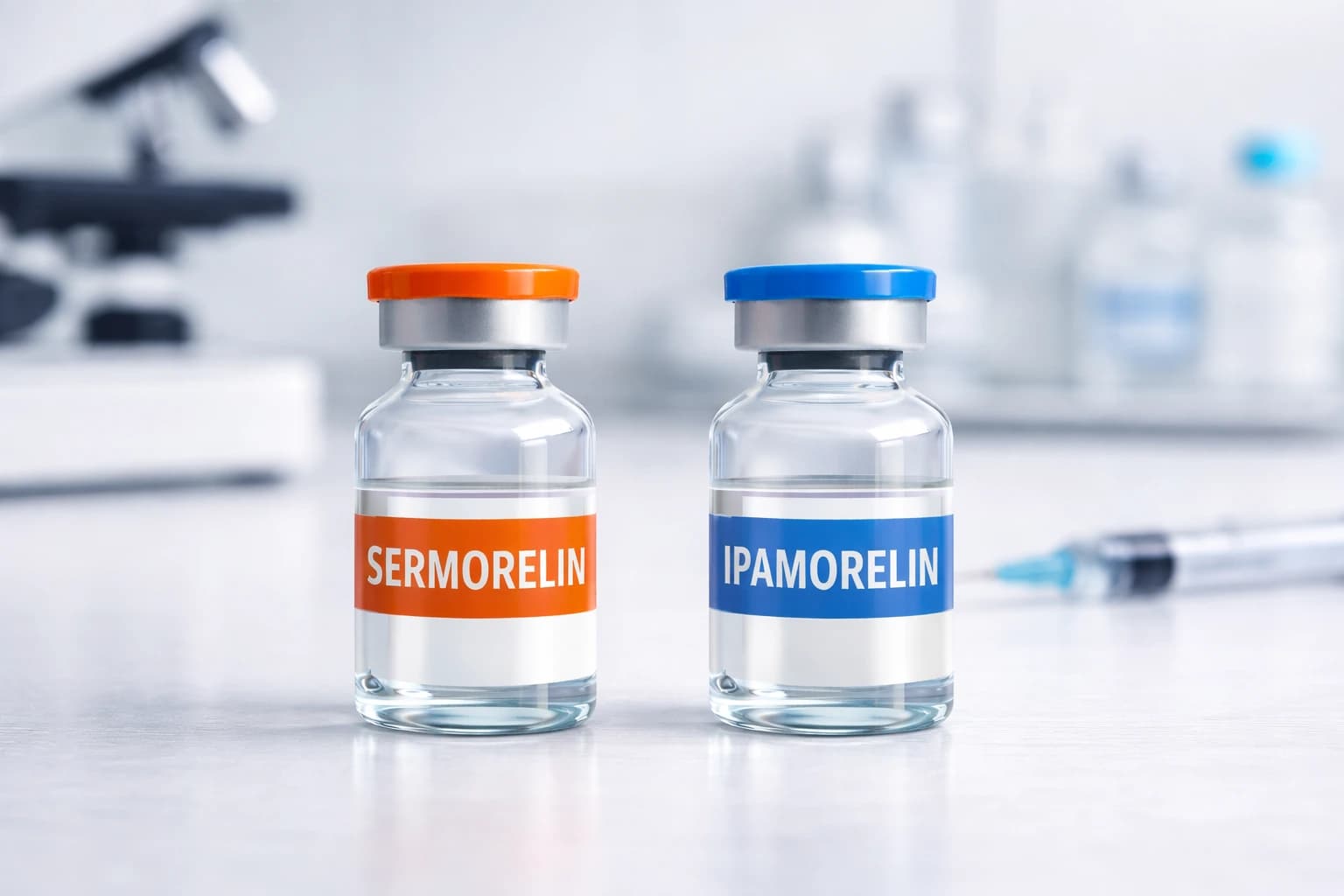
If you’re comparing sermorelin vs ipamorelin, you’re usually looking for a way to stimulate your body’s own growth hormone (GH) release rather than taking GH directly. The most meaningful differences are how each peptide signals the pituitary, how strong the human evidence is for real outcomes, and whether what you’re being offered is FDA-approved, compounded, or research-only (Molitch et al., 2011).

Medically reviewed by:Dr. Tomas Salinas Aguilera, MD
Fact checked
Heli's Fact-Checking Standards
Every piece of content at Heli's adheres to the highest editorial standards for language, style, and medical accuracy. To learn what we do to deliver the best health and lifestyle insights to you, Check out our content review principles.
Overview of Sermorelin and Ipamorelin
What Is Sermorelin?
Sermorelin is a synthetic fragment of growth hormone–releasing hormone (GHRH) that signals the pituitary to release GH in pulses. A branded product (Geref) was previously marketed in the U.S.; FDA later published a determination that it was not withdrawn for reasons of safety or effectiveness, but it is no longer commercially available as an FDA-approved product (FDA, 2013). For background, see the FDA Federal Register determination on Geref (sermorelin acetate).
In many clinics today, “sermorelin” may refer to compounded preparations. Compounded products are not the same as FDA-approved, mass-manufactured drugs, and quality can vary.
What Is Ipamorelin?
Ipamorelin is a small peptide studied as a growth hormone secretagogue that acts through the ghrelin (GHS-R) receptor pathway. Early research described it as relatively selective for GH release compared with some older secretagogues (Raun et al., 1998). See: “Ipamorelin, the first selective growth hormone secretagogue” (PubMed).
Ipamorelin is not FDA-approved as a prescription drug in the U.S., so product quality and labeling accuracy can be a major concern outside legitimate medical oversight.
Difference Between Sermorelin vs Ipamorelin
When people ask about the difference between sermorelin and ipamorelin, it’s most useful to compare (1) signaling pathway, (2) evidence for meaningful outcomes, and (3) practical safety factors like standardization and monitoring.
Mechanism of Action
Sermorelin: Stimulates GH release by acting on the GHRH receptor (a hypothalamic-style signal to the pituitary).
Ipamorelin: Stimulates GH release via the ghrelin receptor pathway (GHS-R) (Raun et al., 1998).
A clear scientific overview of the broader ghrelin/GHS system is available in this NIH/PMC review (Veldhuis & Roelfsema, 2010).
Evidence: What We Can and Can’t Say
For most wellness goals (anti-aging, fat loss, muscle gain), rigorous human evidence is limited and outcomes are hard to separate from sleep, nutrition, training, and placebo effects. Endocrine guidelines focus on diagnosing and treating true adult GH deficiency and emphasize structured evaluation and follow-up rather than “optimizing” GH in otherwise healthy people (Molitch et al., 2011). See the Endocrine Society guideline on adult growth hormone deficiency.
FDA Approval vs Compounding vs Research Use
In real-world practice, this may be the biggest differentiator:
Sermorelin: Previously marketed (Geref), now often encountered via compounding rather than as an FDA-approved commercial product (FDA, 2013).
Ipamorelin: Not FDA-approved; sourcing and standardization vary widely.
If a provider can’t clearly explain what is FDA-approved versus compounded, that’s a major red flag.
Which Is Better: Sermorelin or Ipamorelin?
The question which is better sermorelin or ipamorelin depends less on hype and more on whether there’s a medically appropriate reason to manipulate the GH axis and how results will be measured.
When Sermorelin May Be Preferred
A clinician may prefer sermorelin when they want a GHRH-pathway approach and plan to monitor objective outcomes (symptoms plus relevant labs such as IGF-1 when appropriate). The main limitation is that many offerings are compounded, so consistency depends on pharmacy quality.
When Ipamorelin May Be Preferred
Ipamorelin is often chosen for its ghrelin-receptor pathway and early research describing GH selectivity (Raun et al., 1998). But because it is not FDA-approved, any theoretical advantage can be outweighed by practical concerns about product quality and oversight.
A More Useful Decision Frame
If you’re choosing sermorelin or ipamorelin primarily for fatigue, recovery, or body composition, consider that these symptoms often come from more common issues (sleep disorders, thyroid disease, iron deficiency, overtraining, depression/anxiety, medication effects). A structured endocrine workup is usually a safer first step than choosing a peptide first (Molitch et al., 2011).
Sermorelin Peptide vs Ipamorelin: Use Cases and Limits
Online discussions of sermorelin peptide vs ipamorelin often imply broad “anti-aging” effects. A more evidence-based approach is to define a narrow, measurable goal and decide whether GH-axis manipulation is appropriate at all.
In practice, if a therapy is considered, “success” should be defined with measurable endpoints—sleep quality, function, waist circumference/body composition (when appropriate), and metabolic markers—rather than vague claims alone.
Sermorelin and Ipamorelin: Can You Take Them Together?
People frequently ask can you take sermorelin and ipamorelin together and search phrases like ipamorelin and sermorelin together because the peptides act on different receptors. Mechanistically, dual-pathway signaling is plausible, but strong clinical outcome data in humans are limited.
If a clinician recommends combining sermorelin and ipamorelin, it should come with:
a clear rationale (what problem is being treated),
a monitoring plan (often IGF-1 and metabolic markers),
and explicit stop rules for side effects.
Avoid any source that provides DIY dosing “protocols” or encourages unsupervised injections.
Comparing Related Peptides
Tesamorelin vs Sermorelin vs Ipamorelin
The comparison tesamorelin vs sermorelin vs ipamorelin matters because tesamorelin has a defined FDA-approved indication. Tesamorelin (Egrifta SV) is approved to reduce excess abdominal fat in HIV-associated lipodystrophy and has formal prescribing information, warnings, and monitoring expectations. See the Egrifta SV (tesamorelin) FDA label.
That approval does not make tesamorelin a general weight-loss or “anti-aging” drug for the broader population.
Sermorelin vs CJC 1295
Searches for sermorelin vs cjc 1295 (and cjc-1295 vs sermorelin) usually reflect interest in longer-acting GHRH analog signaling. CJC-1295 has been studied in humans and shown to increase GH and IGF-1 over extended periods in controlled settings (Teichman et al., 2006). See: CJC-1295 trial abstract (PubMed).
However, CJC-1295 is not an FDA-approved medication, so standardization and oversight can vary widely.
Ipamorelin vs CJC 1295
For ipamorelin vs cjc 1295, the common framing is “ghrelin-receptor secretagogue signaling” versus “long-acting GHRH analog signaling.” In practice, safety and appropriateness depend on indication, monitoring, and product reliability—not just receptor theory.
You may also see awkward “stack” phrasing like sermorelin vs cjc ipamorelin or cjc 1295 ipamorelin vs sermorelin. These comparisons mix a single agent versus a combination, which makes risk–benefit decisions more complex and should be handled by a clinician.
Ipamorelin vs Tesamorelin
The comparison ipamorelin vs tesamorelin is often a mismatch: tesamorelin has FDA-labeled use in a specific population, while ipamorelin does not have FDA approval. In practical terms, labeled prescribing information provides clearer safety boundaries than non-approved products.
Choosing the Right Approach
If you’re weighing sermorelin vs ipamorelin, the safest path is to treat this like any other endocrine decision:
confirm whether there’s a medical indication to influence the GH axis,
clarify whether the product is FDA-approved, compounded, or non-approved,
define measurable goals and monitoring before starting,
and avoid anyone promising guaranteed fat loss or dramatic “anti-aging” results.
Frequently Asked Questions
How do clinicians evaluate whether GH-axis therapy is appropriate?
They typically start with history, symptoms, and ruling out more common causes (sleep disorders, thyroid issues, depression/anxiety, overtraining, medication effects). If indicated, they may use lab testing and structured endocrine evaluation to interpret results in context.
What’s a realistic way to track whether therapy is helping?
Why does product standardization matter so much with peptides?
Could GH-axis stimulation worsen acne, swelling, or glucose control?
Is it normal to feel nothing at all?
What should you do if a clinic offers a “one-size-fits-all” stack?
Disclaimer: This website connects patients with licensed healthcare providers who can evaluate medical conditions and prescribe medications when appropriate. Some medications available through this service may be compounded drugs, which are customized formulations prepared by a pharmacy. The FDA does not conduct premarket review for compounded drugs to evaluate their safety, effectiveness, or quality. (See here: https://www.fda.gov/consumers/consumer-updates/it-really-fda-approved). Individual results may vary, and these medications should only be used under the guidance of a qualified healthcare professional. The information in this article is for educational purposes only and should not be considered medical advice. Always consult your healthcare provider before starting any new treatment.
How we reviewed this article:
Sources
History
Helimeds has strict sourcing guidelines and relies on peer-reviewed studies, academic research institutions, and medical associations. We avoid using tertiary references. You can learn more about how we ensure our content is accurate and current by reading our editorial policy.
U.S. Food and Drug Administration. Determination That GEREF (Sermorelin Acetate) Injection… Were Not Withdrawn for Reasons of Safety or Effectiveness. Federal Register. 2013. https://www.federalregister.gov/documents/2013/03/04/2013-04827/determination-that-geref-sermorelin-acetate-injection-05-milligrams-basevial-and-10-milligrams
Molitch ME, Clemmons DR, Malozowski S, Merriam GR, Vance ML. Evaluation and Treatment of Adult Growth Hormone Deficiency: An Endocrine Society Clinical Practice Guideline. Journal of Clinical Endocrinology & Metabolism. 2011. https://academic.oup.com/jcem/article/96/6/1587/2833853
Raun K, Hansen BS, Johansen NL, et al. Ipamorelin, the First Selective Growth Hormone Secretagogue. European Journal of Endocrinology. 1998. https://pubmed.ncbi.nlm.nih.gov/9849822/
Veldhuis JD, Roelfsema F. Integrating GHS Into the Ghrelin System. NIH PubMed Central. 2010. https://pmc.ncbi.nlm.nih.gov/articles/PMC2925380/
Teichman SL, Neale A, Lawrence B, et al. Prolonged Stimulation of Growth Hormone (GH) and Insulin-Like Growth Factor I Secretion by CJC-1295 in Healthy Adults. Journal of Clinical Endocrinology & Metabolism. 2006. https://pubmed.ncbi.nlm.nih.gov/16352683/
U.S. Food and Drug Administration. Egrifta SV (tesamorelin) Prescribing Information. 2019. https://www.accessdata.fda.gov/drugsatfda_docs/label/2019/022505s012s013lbl.pdf