How much vitamin B12 injection should I take?

Medically reviewed by: Dr. Alexandra Christiansen, MD
Written by: David Letsa
Helimeds’ Fact-Checking Standards. Every piece of content at Helimeds adheres to the highest editorial standards for language, style, and medical accuracy. To learn what we do to deliver the best health insights to you, check out our content review principles.

There is no single vitamin B12 injection dose that is right for every adult. The amount and frequency depend on why you need treatment, the exact medication, your symptoms, and whether you have trouble absorbing B12. If you already have a prescription, use its directions rather than a general schedule found online.
If you are holding a vial and wondering how much to draw up, confirm both the prescribed B12 amount and the matching liquid volume with your prescriber or pharmacist before injecting. A vial's concentration is not necessarily your dose.
B12 replacement can treat a deficiency, but fatigue alone does not establish that you need injections. The first decision is whether you need B12 treatment; the next is which preparation, route, and schedule fit your situation.
What determines your B12 injection dose?
The reason for treatment matters
Vitamin B12 helps maintain healthy nerves and supports red blood cell production. A deficiency can cause fatigue, anemia, difficulty concentrating, and nerve-related symptoms such as numbness, tingling, or trouble with balance. These symptoms also have other causes, so they cannot identify the correct treatment by themselves.
A clinician considers whether you have a confirmed deficiency, how serious the symptoms are, and what caused the problem. Someone with limited dietary intake may need a different approach from someone with an ongoing absorption problem. Significant neurological symptoms may also change how promptly treatment is needed and whether injections are preferred.
The American Academy of Family Physicians' review of B12 deficiency identifies limited intake, certain digestive conditions, and some medicines as relevant risk factors. It also explains that oral treatment is appropriate for many people, while intramuscular treatment deserves consideration for severe deficiency or neurological manifestations.
A dose cannot be selected reliably from body weight, how tired you feel, or the number of injections included in a purchased package. Those details do not establish how much B12 your body needs.
The starting plan and maintenance plan can differ
Treating an established deficiency and preventing it from returning are related but different goals. A prescription may include an initial replacement phase followed by a maintenance plan. The frequency may change as the clinician evaluates your response and the underlying cause.
That means two people can receive different instructions without either prescription being wrong. They may have different diagnoses, formulations, treatment stages, or follow-up needs. A schedule used by someone receiving long-term maintenance should not be copied by someone starting treatment.
Ask your clinician to explain which stage your prescription covers and what determines the next step. You should know whether the current instructions continue until a follow-up visit, change on a specified date, or require reassessment before another supply.
A complete injection plan specifies the medication, the amount per dose, the route, and the timing. A number on a vial provides only part of that information.
Do not increase the dose or shorten the interval because you have not noticed a benefit. Persistent symptoms call for reassessment, not an improvised replacement schedule.
How to understand your prescription and vial
Dose, concentration, and volume are different
Much of the confusion about B12 injections comes from several measurements appearing on the same label. The dose describes the amount of B12 prescribed. Concentration describes how much B12 is present in a given volume of liquid. Volume describes how much liquid is measured for administration.
These terms answer different questions:
| Label term | What it tells you | What still needs confirming |
|---|---|---|
| Micrograms, written as mcg, or milligrams, written as mg | The amount of an ingredient | Whether that amount is your prescribed dose or another label detail |
| Micrograms per milliliter, written as mcg/mL | The concentration of an ingredient | The liquid volume that matches your prescription |
| Milliliters, written as mL | A volume of liquid | How much B12 that volume contains |
| Syringe units | Markings on a particular syringe | How the markings correspond to the prescribed volume using that device |
| Total vial volume | How much liquid the container holds | How much you should use for one injection |
Do not assume that a full vial is one dose or that one syringe marking represents a fixed amount of B12 across products. Different concentrations and devices can make the same-looking instruction mean different things.
If the prescription states an ingredient amount but your syringe measures volume, have the dispensing pharmacist confirm the exact measurement. Do not rely on a conversion copied from another person's prescription.
The exact B12 preparation matters
"Vitamin B12 injection" is a category description, not a complete medication identity. Cyanocobalamin and methylcobalamin, for example, are different forms of B12. A preparation may contain B12 alone or combine it with other ingredients.
The medication name, concentration, route, and dispensing directions should all match the prescription. Instructions for one preparation should not be transferred to another simply because both contain B12. An injection into muscle and an injection under the skin also require different administration considerations.
Cleveland Clinic's cyanocobalamin injection information describes administration into a muscle or deeply under the skin and emphasizes following the care team's instructions. That is not permission to choose a route yourself or apply those directions to every compounded combination.
If a refill looks different, check the label before using it. A change in concentration can require a different measured volume even when the intended ingredient dose has not changed.
What to clarify before injecting
If any part of the directions is unclear, pause and resolve it with the prescriber or dispensing pharmacist. Having the vial, prescription label, and syringe available makes that conversation more useful.
Confirm the following:
- The full medication name and every active ingredient.
- The prescribed amount of B12 for each injection.
- The exact liquid volume to measure from this concentration.
- The route of administration and the correct syringe and needle.
- The injection frequency and how long the current instructions apply.
- What to do if you miss a dose or suspect a measurement error.
- The storage requirements and discard instructions after first use.
You can ask the pharmacist to explain the label in plain language and demonstrate the prescribed measurement using the actual device. If a clinician has approved home administration, you also need training in injection technique, infection prevention, and sharps disposal. Written dosing instructions alone do not provide all of that training.
How to find out whether you need B12 treatment
Testing should answer a clinical question
If you are considering injections because of persistent fatigue, a clinical assessment is more useful than selecting a dose from a wellness menu. Poor sleep, anemia from other causes, medication effects, thyroid problems, and other conditions can also contribute to tiredness.
A clinician may review your symptoms, diet, medicines, and digestive history before deciding which tests are appropriate. Initial evaluation commonly includes a blood B12 measurement. Depending on the result and clinical situation, additional testing may help clarify whether there is a deficiency.
One such test measures methylmalonic acid, a substance that can rise when B12 is insufficient. The AAFP review discusses its use when the initial B12 result is borderline. A clinician should interpret that result in context rather than treating an isolated laboratory number as a complete diagnosis.
Tell the clinician about B12 tablets, multivitamins, energy products, and any recent injections. Include the product names and when you last used them. That information helps the clinician understand what preceded the blood test and how to evaluate the results.
The cause changes the long-term plan
Finding low B12 is only part of the assessment. Understanding why it is low helps determine whether treatment is temporary, ongoing, or connected to another condition that needs attention.
Relevant history can include a diet with few B12 sources, gastrointestinal disease, stomach or intestinal surgery, or medicines associated with reduced B12 status. Metformin and proton pump inhibitors are among the medicines discussed in the AAFP review. Their use does not prove deficiency or automatically mean injections are necessary.
Our guide to vitamin B12 intake and dosage for adults provides context on dietary needs and prescription replacement.
Pernicious anemia is another important possibility. It involves impaired B12 absorption related to loss of intrinsic factor, a stomach-produced protein that helps with normal absorption. If an ongoing absorption problem is present, replacing B12 may require a continuing plan even after symptoms improve.
Bring previous laboratory results and records of bariatric surgery or other digestive procedures when available. Also describe whether you have had a deficiency before and what treatment you received. Do not stop a medicine that may affect B12 absorption on your own; the clinician can consider testing and replacement while reviewing its ongoing role.
Are injections better than oral B12?
Many people can use oral treatment
An injection is not automatically the more effective choice for every person with low B12. Oral replacement works for many adults and avoids needles, injection-site problems, and the practical demands of administering an injectable medication.
The AAFP review supports oral supplementation for many patients with B12 deficiency. It recommends considering intramuscular treatment when deficiency is severe or significant neurological symptoms are present. The route should therefore follow the clinical situation rather than the assumption that injections are always stronger.
Some people with absorption difficulties can still be treated with a clinician-directed oral regimen. An absorption problem does not mean that every tablet is useless. However, an ordinary multivitamin should not be assumed to provide an adequate treatment regimen for a diagnosed deficiency.
When comparing oral B12 with injections, ask about the goal of treatment, the evidence relevant to your condition, and how response will be checked. Convenience matters, but so do symptom severity, your ability to follow the plan, and whether follow-up is available.
Our overview of vitamin B12 benefits and side effects discusses oral supplements, injections, and deficiency-related uses.
When injections may be considered
Injections bypass the digestive tract, which can be useful when a clinician needs to address a deficiency without depending on normal gastrointestinal absorption. Severe deficiency, important nerve-related symptoms, or difficulties with an oral treatment plan may influence the decision.
The benefit being sought is correction of the deficiency and its consequences. An injection should not be presented as a guaranteed boost in energy, concentration, or physical performance. Whether symptoms improve depends partly on whether B12 deficiency caused them.
Practical considerations also matter. If you are uncomfortable with needles, have difficulty handling injection supplies, or cannot reliably attend administration visits, explain that before a prescription is finalized. Those concerns can influence which medically appropriate plan is workable.
There is no simple pill-to-shot equivalence that you should use to switch yourself. The amount listed on an oral product and the amount prescribed by injection are not interchangeable instructions. A change in route requires a treatment plan, not just a comparison of label numbers.
B12 shots, fatigue, and compounded MIC+B12
A replacement treatment is different from a wellness claim
B12 has a biological role in normal cell function, but that does not establish that extra injections improve energy in someone who has enough B12. A person with deficiency-related fatigue may benefit from correcting the deficiency. Someone whose fatigue has another cause needs that cause evaluated.
The same distinction applies to weight management. A B12 dose should not be chosen according to a weight-loss goal, a desired change in metabolism, or a promise of increased fat burning. Those goals do not establish a B12 deficiency or a replacement requirement.
Be especially cautious when a treatment package uses a fixed injection frequency without explaining the clinical reason for that schedule. Ask what condition is being treated, what benefit is supported for that preparation, and how the clinician will determine whether it is helping.
Our guide to MIC+B12 ingredients and evidence examines these distinctions.
Treating a nutrient deficiency and purchasing an injection marketed for wellness are different decisions. The reason for treatment should be clear before the amount is selected.
A larger ingredient amount is not evidence of a better outcome. If B12 is not addressing the cause of a symptom, increasing it does not resolve that mismatch.
MIC+B12 is not a B12-only injection
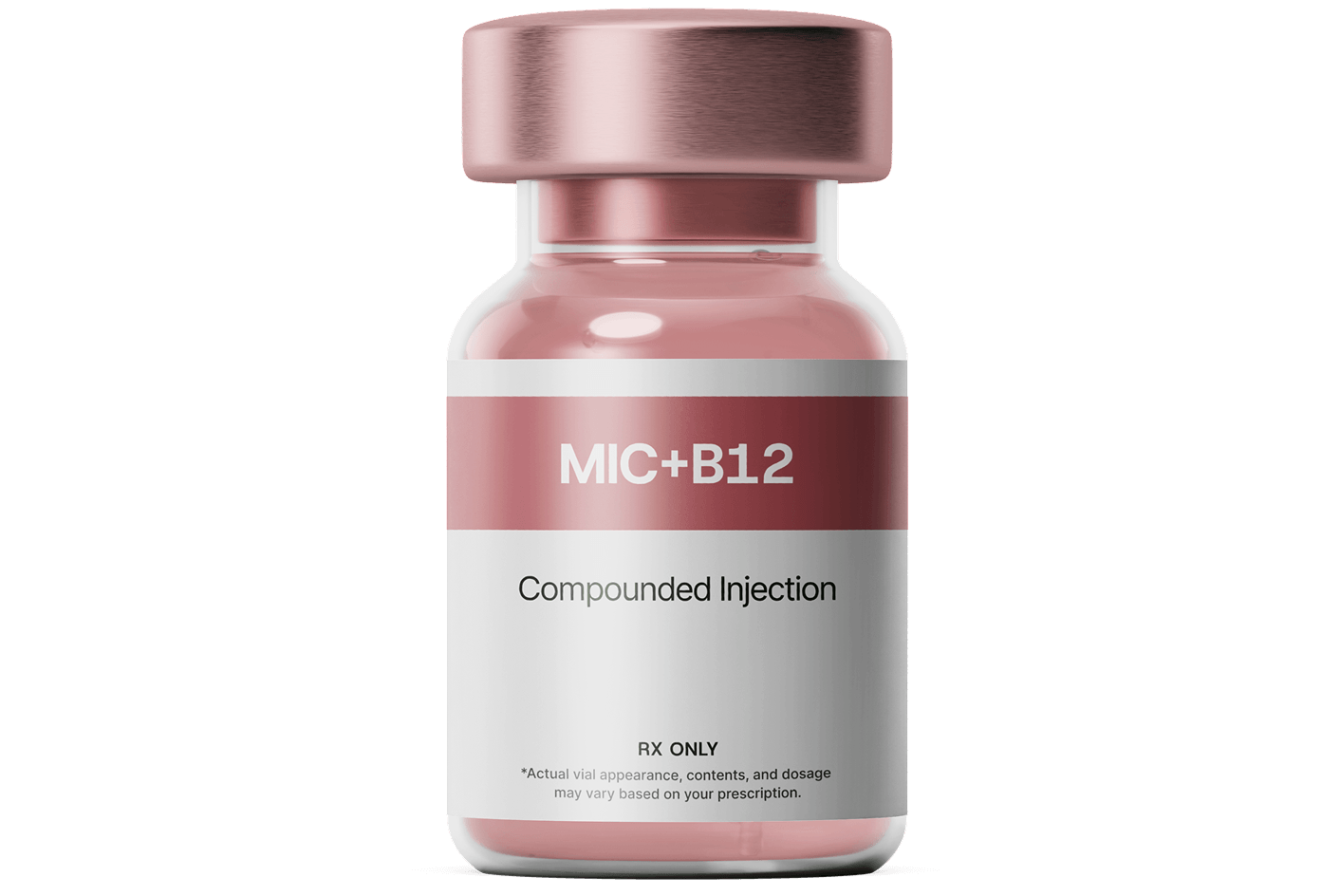
Helimeds lists a compounded MIC+B12 preparation containing methionine, inositol, choline, and methylcobalamin. The B12 ingredient is only one component, so a dose from a B12-only prescription cannot be carried over to that combination.
Compounded drugs are not FDA-approved, and the FDA does not review their safety, effectiveness, and quality before marketing. The presence of B12 does not establish that a compounded combination treats a deficiency appropriately or provides proven benefits for energy or body composition.
If you are considering the MIC+B12 pathway through Helimeds, begin with medical intake and licensed-clinician review. Treatment may be prescribed only if clinically appropriate and permitted in your state; dispensing and fulfillment are separate pharmacy steps. The intake does not guarantee eligibility or a prescription.
For an existing prescription, the treating clinician should clarify the treatment goal and schedule. The dispensing pharmacist can clarify the preparation's concentration, measurement, storage, and discard instructions. Neither the package size nor the number of purchased doses establishes how much you should inject.
Safety and follow-up are part of the dose decision
Discuss relevant conditions and allergies
B12 injections still require a medical history even though B12 is a vitamin. Tell the clinician about prior reactions to B12, cobalt, preservatives, or other medication ingredients. Also disclose kidney disease, severe anemia, pregnancy, breastfeeding, and any known inherited eye disorder, including Leber's disease.
These details can affect the choice of preparation or monitoring. Cleveland Clinic's cyanocobalamin information specifically identifies these types of history as relevant to the care team. Do not assume that safety information for cyanocobalamin covers every ingredient in a compounded combination.
Possible effects include diarrhea and discomfort around an injection site. Contact the clinician if symptoms persist, worsen, or interfere with treatment. Increasing redness, warmth, swelling, drainage, or fever after an injection should receive medical assessment rather than being dismissed as routine soreness.
Call 911 for trouble breathing, swelling of the lips or throat, fainting, or other signs of a severe allergic reaction. New chest pain or severe shortness of breath also requires emergency evaluation, not a routine customer-support message.
Know what follow-up is checking
Treatment follow-up should assess whether the plan is correcting the deficiency and whether symptoms are improving. Depending on the situation, that may involve blood work, a review of neurological symptoms, and reassessment of the suspected cause.
Improvement does not necessarily mean the underlying absorption problem has resolved. Conversely, continuing fatigue does not automatically mean the dose is too low. Another condition, a second nutritional problem, or a different explanation for symptoms may need evaluation.
Before your follow-up, record:
- The dates of injections and the prescribed amounts administered.
- Any missed doses or uncertainty about a measurement.
- Changes in fatigue, numbness, balance, concentration, or daily functioning.
- Side effects and when they occurred relative to an injection.
- New medicines, supplements, diet changes, or medical diagnoses.
Report new or worsening numbness, weakness, or difficulty walking promptly. Do not wait for a routine refill to mention neurological changes. Sudden weakness, trouble speaking, or other possible stroke symptoms require calling 911.
If you think you injected the wrong amount, contact the prescriber, pharmacist, or U.S. Poison Control at 1-800-222-1222 promptly. Keep the vial and syringe information available, and do not take another dose to try to correct the error yourself.
The next step is a complete, verified prescription
The right amount of injectable B12 comes from a treatment plan matched to your diagnosis and exact medication. It cannot be determined safely from a generic online schedule, the vial's total size, or the intensity of your fatigue.
If you already have a prescription, verify the ingredient dose, measured volume, route, and timing before your next injection if anything is unclear. If you are considering treatment, start with an evaluation of your symptoms, B12 status, and possible causes of deficiency. Discuss oral replacement as well as injections.
For a compounded MIC+B12 consultation through Helimeds, disclose your symptoms, existing supplements, and any prior deficiency treatment. Prescribing depends on clinical assessment, and that combination should not be assumed to replace a B12-only treatment plan.
Review how care through Helimeds works for the intake, provider-review, and pharmacy-fulfillment steps.
This article provides general health information and does not replace advice from your licensed healthcare professional.
Frequently asked questions
Is one full vial of B12 the correct dose?
Not necessarily. A vial may contain more than one dose, and its total volume does not tell you how much you should inject. Confirm the prescribed ingredient amount and matching liquid volume with the dispensing pharmacist before using it.
Should I take B12 injections if I eat a vegan diet?
A vegan diet makes reliable B12 intake important, but it does not automatically mean you need injections. Fortified foods and oral supplements may be appropriate, depending on your intake and clinical circumstances. Symptoms or concerns about deficiency warrant assessment rather than choosing an injection schedule yourself.
Can I take B12 tablets while receiving injections?
Tell your clinician about all B12-containing tablets, multivitamins, and other supplements before combining them with injections. Additional B12 may be unnecessary and can complicate understanding your overall treatment and laboratory results. Your clinician can clarify whether the oral product has a role in your plan.
How quickly should I feel better after a B12 injection?
There is no guaranteed response time, and an immediate increase in energy is not a reliable test of whether treatment is appropriate. Recovery depends on whether deficiency caused the symptoms, their severity, and other health factors. Discuss persistent or worsening symptoms with your clinician rather than increasing the dose or taking injections more often.
History
Current Version
Written by David Letsa
Medically reviewed by Dr. Alexandra Christiansen, MD