Get GLP1+GIP for $37.25/week
Start Now

NMN vs NAD: Which Supplement Makes More Sense for Healthy Aging?

NMN vs NAD
Heli's Fact-Checking Standards

Every piece of content at Heli's adheres to the highest editorial standards for language, style, and medical accuracy. To learn what we do to deliver the best health and lifestyle insights to you, Check out our content review principles.

Many people searching online for "nmn vs nad" or "nmn or nad" want to know whether taking nicotinamide mononucleotide (NMN) or a NAD⁺ supplement is more likely to support energy, metabolism, and overall health. Both approaches aim to influence the same cellular pathway, but they do so in different ways and with different levels of evidence behind them.

This article is for general information only and is not personal medical advice. Always talk to a qualified healthcare professional before starting NMN, NAD⁺ infusions, or any nicotinamide mononucleotide supplement, especially if you have medical conditions, take prescription drugs, are pregnant, breastfeeding, or under 18.

What Is NMN and What Is an NMN Supplement?

Nicotinamide mononucleotide (NMN) is a small molecule that your body uses as a direct building block to make NAD⁺ (nicotinamide adenine dinucleotide). Because NAD⁺ is essential for energy production and DNA repair, interest in NMN has grown rapidly in the context of longevity and "nmn anti aging" discussions. When people ask "what is nmn" or "what is nmn supplement," they are usually asking how this precursor fits into that bigger picture.

Tiny amounts of NMN occur naturally in foods like broccoli, edamame, and avocado, but diet alone provides far less than is found in supplements. Commercial products marketed as an "nmn supplement" or "nicotinamide mononucleotide supplement" typically provide 125–500 mg per day in capsule or powder form. In that sense, "what are nmn supplements" is straightforward: they are concentrated forms of nicotinamide mononucleotide (nmn) designed to support the body's own NAD⁺ production.

From a practical standpoint, "what is nmn used for" comes down to boosting NAD⁺-dependent processes that support cellular energy, repair, and resilience. These nmn supplement benefits are still being mapped out in humans, but preclinical work and early trials suggest potential advantages for metabolic health and exercise performance, especially in older or metabolically at-risk adults.

Understanding NAD vs NMN: The Difference Between NMN and NAD

NAD⁺ is a coenzyme present in every living cell, where it helps turn food into ATP and fuels enzymes involved in DNA repair and cellular stress responses. NMN, by contrast, is a direct "nmn precursor to nad": your cells convert NMN into NAD⁺ through a short enzymatic pathway. That means the fundamental difference between nmn and nad is that NAD⁺ is the final working coenzyme, while NMN is a raw material your body uses to build and replenish it.

Because of this, the answer to "is nmn the same as nad" is clearly no—they are related but distinct molecules. NAD⁺ does the work; NMN simply feeds the system that maintains NAD⁺ levels.

NMN vs NAD in Real-World Use

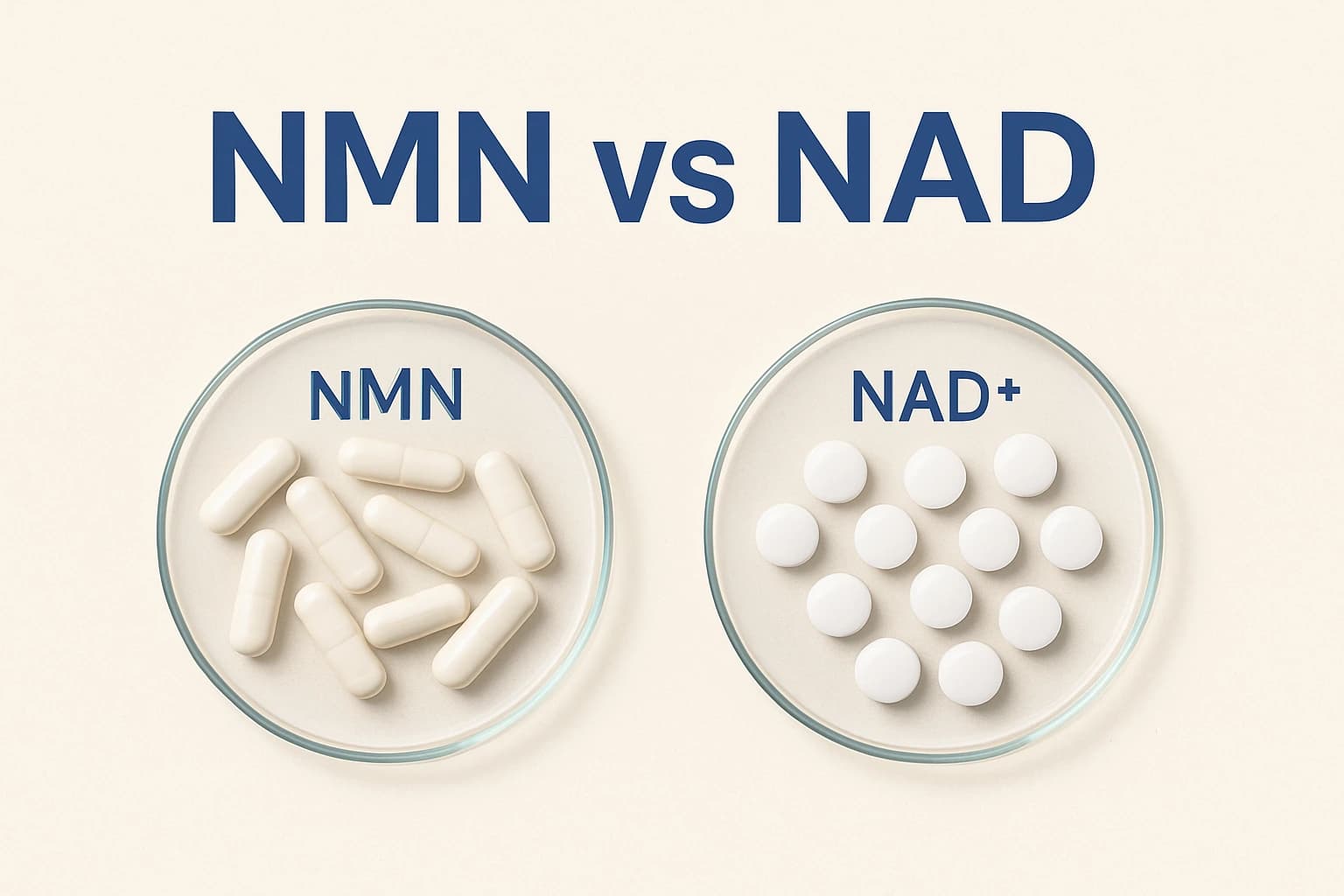
In practice, "nmn vs nad" usually refers to the choice between taking an oral NMN supplement or receiving NAD⁺ by intravenous infusion. Oral NAD⁺ is a relatively large molecule that may be broken down in the gut, whereas NMN appears more stable and is more readily converted into NAD⁺ inside cells. That makes NMN a more convenient option for long-term, at-home use.

Some clinics offer NAD⁺ infusions for issues ranging from fatigue to addiction recovery, but there is still limited, mixed evidence for these protocols, and they are expensive and invasive, as even consumer overviews on NAD⁺ supplements and anti-aging point out.

For most generally healthy adults, the convenience and tolerability of oral NMN make it a more practical option when deciding between "nmn or nad," though lifestyle factors like sleep, nutrition, and exercise remain the real foundation of longevity.

NAD⁺ vs NMN in Supplement Form

The phrase "nad+ vs nmn" is common in marketing, but it can be misleading because the two approaches are not directly comparable. Infusion-based NAD⁺ protocols can raise blood NAD⁺ levels quickly but require medical supervision and carry the usual risks of IV therapy. Oral NMN is taken more gradually over months and aims to nudge the body's own NAD⁺ system rather than create a short-term spike.

Regulators and experts emphasize that we still lack long-term safety data for either approach. For now, NAD⁺ infusions are best viewed as an experimental intervention, while NMN is an over-the-counter supplement with emerging but still incomplete evidence.

NMN Benefits, Longevity, and Anti-Aging Claims

When people search for "nmn benefits," "benefits of nmn," or "nmn longevity," they are usually interested in how raising NAD⁺ might affect aging. In animal studies, NMN and other NAD⁺ precursors can improve mitochondrial function, insulin sensitivity, vascular health, and markers of neurodegenerative disease. These findings are described in a detailed review on nicotinamide mononucleotide as an anti-aging health product.Some models even show modest lifespan extension, which is why NMN often appears in headlines about "nmn anti aging."

In humans, the story is more modest but still intriguing. Small clinical trials suggest that NMN can raise blood NAD⁺ levels and improve certain metabolic markers, such as insulin sensitivity and muscle function, in select groups. This is where phrases like "nmn effects" and "nmn results" come from: the goal is not instant transformation, but subtle improvements in how cells handle energy and stress.

When you see dramatic promises, it is worth asking, "does nmn work" and "does nmn really work" for real-world outcomes? So far, the best evidence supports NMN as a way to boost NAD⁺ and slightly improve metabolic and physical performance in specific populations—not as a guaranteed way to slow or reverse all aspects of aging.

NMN Benefits for Women

Search interest in "nmn benefits for women" has grown because some of the earliest NMN trials involved postmenopausal women with metabolic risk factors. In those studies, NMN improved muscle insulin sensitivity and appeared to support healthier glucose handling, which could be important for long-term cardiometabolic health.

Women may also notice subjective changes in energy, exercise tolerance, or even skin quality, but those outcomes have not been rigorously measured in large, sex-specific trials. For now, "nicotinamide mononucleotide benefits" in women are best thought of as potential metabolic benefits rather than proven hormone or beauty effects.

What Does NMN Do in the Body and How Does NMN Work?

Mechanistically, "how does nmn work" and "what does nmn do for the body" both come back to NAD⁺. After you swallow NMN, it is absorbed in the small intestine and taken up into cells via specific transporter proteins. There, enzymes convert it into NAD⁺, which then participates in hundreds of reactions involved in energy production, DNA repair, and cellular stress responses.

From this perspective, "what does nmn do" is indirect: it replenishes the NAD⁺ pool, which in turn supports mitochondrial ATP production, sirtuin activity, and other NAD⁺-dependent enzymes. That is why NMN is often described as a way to "support healthy aging" rather than as a targeted treatment for any single disease.

Because NAD⁺ touches so many processes, it is fair to wonder "is nmn good for you" or whether there are trade-offs. Short-term trials suggest that NMN is generally well tolerated, but we still do not know the long-term consequences of keeping NAD⁺ artificially elevated for years at a time.


NMN Research and Studies: What We Know So Far

The body of "nmn studies" and "nmn research" has expanded quickly in the last few years. Preclinical work in mice and other models shows that NMN supplementation can improve metabolic health, enhance vascular function, and in some cases extend lifespan, consistent with broader reviews of NAD⁺ in aging, metabolism, and neurodegeneration.

Human data are still limited but growing. A randomized, placebo-controlled trial in postmenopausal women with prediabetes found that daily NMN improved muscle insulin sensitivity, a key metabolic marker, in line with results from the Science trial on nicotinamide mononucleotide in women with prediabetes. PubMed Other small trials in healthy middle-aged and older adults show that NMN can safely increase blood NAD⁺ and may modestly improve measures like walking distance or muscle strength over 8–12 weeks, for example in a study of oral nicotinamide mononucleotide supplementation.

At the same time, reviews of NAD⁺-boosting compounds emphasize uncertainties: sample sizes are small, study durations are short, and we lack long-term safety and outcome data, as highlighted in a systematic overview of dietary NAD⁺-boosting compounds in humans.That is why many experts stress that NAD⁺ precursors should still be considered experimental, even if short-term "nmn results" look promising.

NR vs NMN and Other NAD⁺ Precursors

NMN is not the only way to raise NAD⁺ levels. Nicotinamide riboside (NR) is another popular precursor, and many people compare "nr vs nmn" when deciding which supplement to try. Both feed into the NAD⁺ salvage pathway, but they use slightly different transporters and enzymes.

Human trials show that both NR and NMN can boost circulating NAD⁺. NR currently has more published clinical data, while NMN is catching up with newer studies. It is still too early to say definitively whether one is better than the other; for now, the choice often comes down to availability, cost, and individual tolerance rather than clear superiority.

Should You Take NMN or NAD?

With so much marketing noise, questions like "should i take nmn or nad" and "is it better to take nmn or nad" are completely understandable. There is no one-size-fits-all answer, but a few principles can help frame the decision.

For most generally healthy adults curious about NAD⁺ support, oral NMN (or NR) is a more practical starting point than NAD⁺ infusions. It is easier to take, less invasive, and backed by a growing—if still limited—body of human data. That said, supplements are not a substitute for core lifestyle strategies like sleep, exercise, nutrition, and stress management, which have far stronger evidence for supporting longevity than any pill.

The deeper questions "does nmn work" and "does nmn really work" depend on what you expect. If you hope NMN will radically transform your appearance or add decades to your life, current science does not support that. If you are looking for a relatively well-tolerated way to nudge NAD⁺ and potentially improve some metabolic or performance markers, NMN may offer modest benefits.

Safety, Side Effects, and Long-Term Uncertainty

Short-term human trials suggest that NMN is generally safe and well tolerated, with side effects like digestive upset, headache, or sleep changes reported in a minority of participants. However, there are still important unknowns, including how long-term use might affect cancer risk, cardiovascular events, or other age-related diseases.

Because of these uncertainties, experts usually advise caution in people with a history of cancer, serious chronic disease, or those who are pregnant, breastfeeding, or very young.If you decide to try NMN, it is wise to involve a clinician who understands your medical history and can help monitor for any unexpected "nmn effects" over time.

Summary: Is NMN Effective and Is It Right for You?

Pulling this together, "is nmn effective" depends on how you define success. Existing evidence suggests that NMN can reliably raise NAD⁺ levels and may improve specific metabolic and functional markers in certain groups. When used thoughtfully and alongside a healthy lifestyle, it may be a reasonable option for some adults who understand that the benefits are likely to be modest.

Ultimately, "is nmn good for you" is a question best answered with your own clinician, considering your goals, risk factors, and other medications. Supplements like NMN sit at the frontier of longevity science, where hope and hype can easily outpace data. Used carefully, they may have a role—but they are not magic, and they are not a replacement for the basics.

Disclaimer

Disclaimer: This website connects patients with licensed healthcare providers who can evaluate medical conditions and prescribe medications when appropriate. Some medications available through this service may be compounded drugs, which are customized formulations prepared by a pharmacy. The FDA does not conduct premarket review for compounded drugs to evaluate their safety, effectiveness, or quality. (See here: https://www.fda.gov/consumers/consumer-updates/it-really-fda-approved). Individual results may vary, and these medications should only be used under the guidance of a qualified healthcare professional. The information in this article is for educational purposes only and should not be considered medical advice. Always consult your healthcare provider before starting any new treatment.

How we reviewed this article:
Sources
History

Helimeds has strict sourcing guidelines and relies on peer-reviewed studies, academic research institutions, and medical associations. We avoid using tertiary references. You can learn more about how we ensure our content is accurate and current by reading our editorial policy.

  • Rajman L, Chwalek K, Sinclair DA. Therapeutic potential of NAD-boosting molecules: The in vivo evidence. Cell Metabolism. 2018. Available at: https://www.cell.com/cell-metabolism/fulltext/S1550-4131(18)30478-5

  • Trammell SAJ et al. Nicotinamide riboside is uniquely and orally bioavailable in mice and humans. Nature Communications. 2016. Available at: https://pubmed.ncbi.nlm.nih.gov/26896175/  

  • Yoshino M et al. Nicotinamide mononucleotide increases muscle insulin sensitivity in prediabetic women. Science. 2021. Available at: https://www.science.org/doi/10.1126/science.aaw2479

  • Hong W et al. Nicotinamide mononucleotide: A promising molecule for human health and longevity. Nutrients. 2024. Available at: https://pmc.ncbi.nlm.nih.gov/articles/PMC11205942/  

  • Grant JE et al. Intravenous NAD⁺ for neurological and metabolic conditions: Pharmacokinetics and clinical observations. Frontiers in Neuroscience. 2021. Available at: https://www.frontiersin.org/articles/10.3389/fnins.2021.667304/full

  • Yusri K et al. The role of NAD⁺ metabolism and its modulation in ageing and age-related diseases. Nature Reviews Bioengineering. 2025. Available at: https://www.nature.com/articles/s44324-025-00067-0  

  • Camillo L et al. Nicotinamide: A multifaceted molecule in skin health and disease. Medicina. 2025. Available at: https://www.mdpi.com/1648-9144/61/2/254  

  • EP3063163A1. Nicotinamide riboside compositions for topical use in treating skin conditions. European Patent Office. 2016. Available at: https://patents.google.com/patent/EP3063163A1/en  

Share this post:

Related Posts